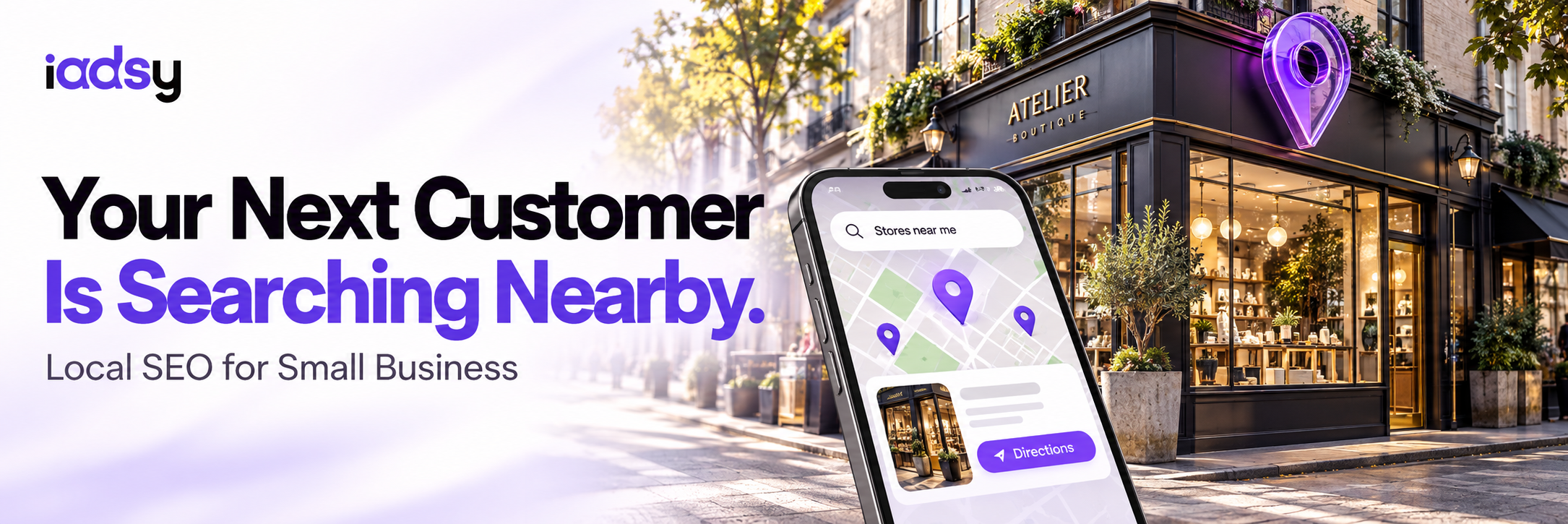

People use Google in two ways. Someone types "how to choose running shoes" because they want information. Someone else types "shoe store near me" because they want to buy, right now, at whatever place is closest.
Local SEO is about that second person. Their wallet is already out; they're just deciding where to spend. If your business doesn't appear at that moment, they go to a competitor. Not a better one. Just the one Google showed first.
I do Local SEO for businesses in the US and Europe: optical boutiques in Manhattan, furniture stores, service companies. The pattern repeats every time. The business exists and so do the customers, but Google doesn't know about the business. Or it does, and buries it on page five, where nobody looks.
Why Local SEO Is Not "Regular SEO"
Regular SEO means optimizing your website to rank across a whole country, or the whole world. Local SEO means optimizing your presence for people in one city, one neighborhood, sometimes a few blocks.
That's a huge difference. With regular SEO you're up against millions of websites. With Local SEO it's a few dozen businesses nearby, and ranking first among 30 competitors is far easier than among 3 million.
Then there's intent. Someone searching "dentist near me," "phone repair Brooklyn" or "optician Upper West Side" isn't browsing. They're ready to buy, book, or walk in. That's why Local SEO converts significantly better than regular organic traffic: the intent is there before they ever see your name.
Google Business Profile: Your Storefront in Google
A local business without a Google Business Profile (formerly Google My Business) is close to invisible. The profile is free, and it's what puts you on Google Maps and in the "Local Pack," the three map results at the top of the search page.
Most businesses do have one. It's usually about 30-40% complete: name, address, phone, done. Google weighs dozens of signals when deciding who shows up first, and a half-empty profile tells it the business is either not serious or not active.
Fill in all of it properly: the business name exactly as it appears on your storefront, primary and secondary categories, hours, address, phone, website, a description that uses relevant keywords, photos (think 20-30+, not three), service areas, attributes. Most important of all, keep updating it.
A complete profile is only where things start. Actually optimizing it to outrank competitors is a separate process with plenty of nuance, and I won't cover it here. That's the work we do for clients, and each business needs its own approach.

Reviews: The Fuel of Local SEO
Google says plainly that reviews affect local rankings. Quantity counts, but so do quality, variety, and how the business responds.
A store with 150 reviews at 4.7 will rank above a store with 12 reviews at a perfect 5.0. Counterintuitive? Not really. Google trusts more data, and so do shoppers.
What most businesses skip is asking. They simply don't ask customers for reviews. Happy customers rarely post one on their own; unhappy ones almost always do. Without an active effort to collect reviews, your rating will sit lower than it deserves.
Some ways of collecting reviews work far better than "please leave us a review." That's a topic for another post.
One rule that matters: answer every review, positive and negative. Google takes it into account, and shoppers read your replies. A polite, constructive response to a bad review makes a business look better than silence does.

Citations and NAP: What Everyone Overlooks
NAP means Name, Address, Phone. These details must match everywhere: Google Business Profile, Yelp, Facebook, Apple Maps, Bing Places, industry directories, your own website.
Obvious, right? Yet plenty of businesses list one phone number on Google and another on Facebook, or include "Suite 200" in their address on one site and drop it on the next. Google reads that as uncertainty. It can't tell which version is correct, so it trusts the business less.
Auditing and fixing NAP across every platform is routine work, but it matters a lot. Your business is probably also listed, with wrong details, in places you've never heard of.
Your Website Also Needs to Work for Local Search
The profile isn't the whole picture. Your website carries a lot of weight in Local SEO too. Pages built around local keywords, structured data (Schema markup), a contact page with an embedded map, meta tags that name your city and neighborhood: each of these tells Google the business is real and operates in a specific place.
With multiple locations, every location needs its own page with unique content. Not the homepage copied with a new address. Real content about that location, its neighborhood, and what you offer there.
Technical optimization for Local SEO is a discipline of its own, from proper URL structure to Schema LocalBusiness markup and hreflang on multilingual sites. Details like these are what separate a business on page one from one nobody finds.
Why "I'll Do It Myself from YouTube Videos" Rarely Works
I understand wanting to handle it yourself. Google "how to do local SEO," read three articles, fill in your profile, wait. The catch is that Local SEO isn't a one-off task. It never stops.
Google adjusts its local ranking algorithms several times a year. Competitors keep moving. Reviews have to be collected systematically, citations monitored, website content refreshed.
Some nuances no article will cover, because they depend on your niche, your city, and who you're competing with. What works for a dentist in one city won't work for an optical boutique in Manhattan, and the reverse is just as true. Template checklists get template results.
How to Know If You Need Local SEO
Here's a quick test. Do customers come to you in person, or look for your services in a particular city? If so, you needed Local SEO yesterday. If you're fully online and sell worldwide, it isn't your priority.
But a physical location, a service business tied to a region, even an online store aimed at one market: for any of these, Local SEO can become your most effective and cheapest way to win customers. They're already searching. You just have to be where they look.
What's Next
At iAdsy we set up and run Local SEO for businesses in the US and Europe. We handle the full cycle: an audit of your current presence, Google Business Profile optimization, a review strategy, citation cleanup, website optimization for local search, and ongoing monitoring.
No two projects are alike. Local SEO isn't a checklist; it's a strategy built for one business, in one city, against specific competitors.
Curious how your business looks in local search right now? Get in touch and we'll run an analysis.
→ DM on Instagram: @iadsy_com
→ Telegram: t.me/iadsy_ecom
→ Or via our website: iadsy.com
Or .
Vasyl Staroshchuk
Co-founder of iAdsy
I’m Vasyl, co-founder of iAdsy. We build, fix, and scale eCommerce stores and local businesses online, in US and EU markets.
Build It. Launch It.
Keep Getting Better.
eCommerce Next Level · An 8-week live course