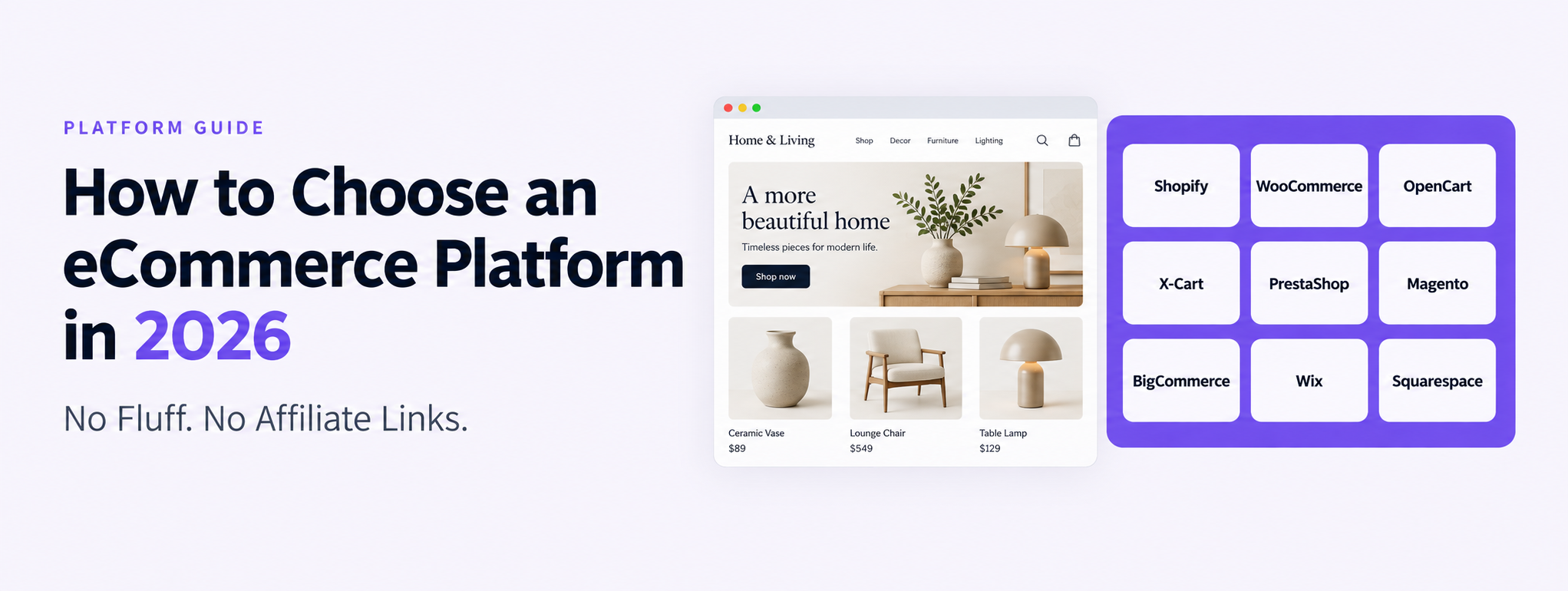

Over the past 15 years I've worked with Shopify, WooCommerce, BigCommerce, OpenCart, X-Cart, PrestaShop, and even custom-built platforms. I've built stores on them, migrated between them, and fixed what broke. And here's the thing: there is no perfect platform. There's only the right platform for your specific situation.
This isn't going to be a "top platforms" ranking. I'm just going to tell you what I've seen in practice and who each one works for. No affiliate links, no hidden agenda.
Shopify

I'll start with Shopify because it's what we use for most new projects.
Shopify is the iPhone of eCommerce platforms. Everything works out of the box. Hosting, security, updates, payment processing, SSL, speed, mobile. You don't have to think about the technical side. At all. You think about your product and your sales, not about why your site went down at 3 a.m.
Who Shopify is great for: you're launching your first store, you don't have a technical team, you want to be up and running in weeks not months, you're selling physical products to the US or European market.
Where Shopify falls short: you need very deep customization that apps can't cover, you have complex business logic (B2B with individual pricing per client, advanced product configurators), or you fundamentally want to control every byte of your site.
Cost: starts at $39/month for the basic plan. You can use a free theme. But be ready for apps to add another $50-200/month for a properly functioning store. That's the part nobody warns beginners about.
WooCommerce

WooCommerce is a plugin for WordPress. If you already work with WordPress and understand how it's put together, WooCommerce might be a logical choice.
The main advantage: total control. You own the code, the database, the hosting. You can do literally anything. But here's the catch: "can do anything" doesn't mean "everything works out of the box." You need to set up your own hosting, keep up with updates, deal with plugin conflicts, and think about security yourself.
I've seen WooCommerce stores that ran beautifully. And I've seen stores where every WordPress update broke something new. The difference always came down to one thing: whether there was someone watching it regularly.
Who WooCommerce works for: you already have a WordPress site with traffic and want to add a sales component, you have a technical person on your team (or you are that person), you need specific customization that's easier to build in PHP.
Where WooCommerce causes headaches: you're a beginner with no technical background, you don't have anyone to maintain it, you're planning to scale quickly (WooCommerce doesn't handle load well without serious optimization).
Cost: the plugin itself is free, but hosting ($20-100/month), SSL, a theme, payment plugins, and maintenance time add up. In reality it's not cheaper than Shopify, and often costs more.
OpenCart

OpenCart is popular in the CIS region and among people looking for a free open-source solution. At first glance it looks attractive: free, easy to install, plenty of extensions.
But in practice it's more complicated. OpenCart's architecture is outdated. The codebase in places makes experienced developers cringe. Upgrades between versions are painful because backward compatibility isn't a priority. The extension ecosystem exists, but quality is all over the place: one module works perfectly, another breaks the entire store.
I've worked with OpenCart stores and I'll be honest: for starting out in 2026, there are better options. If you already have an OpenCart store that's running and making money, you don't need to rush a migration tomorrow. But if you're planning to scale or expand into new markets, it's worth thinking about a move.
Who it's for: tight budget and a technical person who knows the platform. Possibly fine for testing an idea, but not for long-term business growth.
X-Cart

X-Cart is a platform with a long history that's been through several transformations. It currently exists in two flavors: cloud (SaaS) and self-hosted.
The advantage of X-Cart is that it offers more customization than Shopify while being less complex than Magento. Multi-currency, multi-language, flexible discount systems, and decent B2B functionality out of the box.
But there are downsides. The community is significantly smaller than Shopify's or WooCommerce's. Finding a developer is tough. Documentation isn't always current. And the self-hosted version isn't cheap, and neither is the cloud option.
I've worked with X-Cart and seen projects where it was the perfect fit: mid-size businesses that needed customization, where Shopify felt too limiting but Magento was overkill. But that's a narrow niche. For most new projects, it's simpler to start on Shopify and scale from there.
PrestaShop

PrestaShop is another open-source option, very popular in Europe, especially in France, Spain, and Poland. It's free, comes with solid functionality out of the box, and has a large module marketplace.
On paper, PrestaShop looks like a sweet spot between WooCommerce and Magento. More mature than OpenCart, less massive than Magento, and built specifically for eCommerce (unlike WooCommerce which is an add-on to a blogging engine).
But there are catches. Modules on the marketplace are paid and not cheap, with few quality free options. Upgrades between major versions are painful, migrating from PrestaShop 1.6 to 1.7 is essentially rebuilding the store. The English-speaking community is smaller than Shopify's or WooCommerce's, which makes finding solutions harder if you're targeting the US market.
I've worked with PrestaShop and here's my take: for the European market it's a solid option, especially if your team already knows the platform. But for entering the US market or for a brand new project in 2026, there are simpler paths.
Who it's for: European market, you have a technical person with PrestaShop experience, you need more control than Shopify offers but without the complexity of Magento.
Magento (Adobe Commerce)

Magento is a platform built for big players. Millions of SKUs, complex B2B logic, custom integrations with ERP and CRM systems. If you have a catalog of 50,000+ products with different price lists for different clients, Magento might be justified.
But the cost of entry and maintenance is massive. Development on Magento costs multiples of what you'd pay on Shopify or WooCommerce. Finding a good Magento developer is hard and expensive, and the talent pool is shrinking every year. Every change takes longer. Every update requires thorough testing.
If you're already on Magento and it's working, the question isn't "should I migrate" but "when and how." Support for Magento Open Source is getting pricier. Sooner or later, that's going to become a problem.
Who it's for: 50,000+ SKU catalogs, complex B2B logic, high volume, budget for development and ongoing maintenance. For everyone else, there are simpler and cheaper options.
BigCommerce

BigCommerce is similar to Shopify in concept (hosted, everything included), but with a few differences. More built-in features without needing apps, no transaction fees, better native multi-currency support.
But the ecosystem of themes and apps is smaller. The community is smaller. Fewer developers on the market. For most new stores, the downsides outweigh the upsides.
I recommend BigCommerce in very specific cases: when Shopify doesn't fit because of a particular need that BigCommerce covers natively. Not "because it's also good," but because there's a concrete reason.
Wix and Squarespace


I'll keep this short: for a serious eCommerce business, these aren't it. For a photographer's portfolio with print sales, for a landing page with one product, for testing an idea, maybe. But if you're planning to build a real business, you'll hit limitations very quickly that you simply can't work around.
How to choose: my framework
After 120+ projects, I've settled on a simple framework:
If you're just starting out and want to sell physical products online, start with Shopify. Not because it's the best at everything, but because it gets you from "idea" to "first sale" the fastest. And that's the only thing that matters at the beginning.
If you already have a WordPress site with traffic and want to add sales, WooCommerce makes sense. But only if there's someone who's going to maintain it.
If you have a large catalog and complex logic, take a look at Magento or BigCommerce. But talk to someone who's actually worked with these platforms. Don't read comparison articles, because they're all written by platform partners. Talk to practitioners.
If you're currently on OpenCart, X-Cart, PrestaShop, WooCommerce, or Magento and feel like your platform is holding you back, think about migrating. It's scary, but we've moved dozens of stores between platforms. With the right plan, you don't lose your SEO, your data, or your customers.
One piece of advice I give everyone
Don't choose a platform based on the fact that you liked a competitor's website. You don't know how much they paid for development, how much they spend on maintenance, or how many problems they deal with every day. Choose based on your own resources: budget, time, technical skills, and scale.
Stuck on a platform that's holding your business back?
We handle migrations between any platforms: OpenCart, X-Cart, PrestaShop, WooCommerce, Magento to Shopify and other directions. Without losing your SEO rankings, data, or customers.
Reach out and we'll review your situation. We'll tell you whether a migration makes sense, how long it would take, and what's involved. No strings attached.
DM on Instagram: @iadsy_com
Telegram: t.me/iadsy_ecom
Or via our website: iadsy.com
Vasyl Staroshchuk
Co-founder of iAdsy
I'm Vasyl, co-founder of iAdsy. We build, fix, and scale eCommerce stores. 15+ years, 120+ projects, US and EU markets.
Choose your platform.
Build your next chapter.
eCommerce Next Level · An 8-week live course