
Most store owners ignore email marketing. Because it’s “boring,” “outdated,” “who even reads email in 2026.” And then they sit there wondering why their entire revenue depends on ads that cost more every single month.
Here’s a number that should flip your thinking: email marketing in eCommerce returns an average of $36 for every $1 spent. Thirty-six dollars. That’s the highest ROI of any marketing channel out there. Higher than Meta Ads. Higher than Google. Higher than SEO, at least in the short run.
And the best part isn’t even the numbers. It’s that once you set up automated flows, they run 24/7 without you doing a thing. You’re asleep and email is selling for you. I’m serious.
I’ve built email systems for dozens of eCommerce projects. And I know exactly what you actually need at the start and what you don’t. Not 50 flows. Not 200 templates. Three automated series and one popup. Two hours of your time. That’s it.
Let’s break it down.
Pick a Platform. Don’t Overthink It. 15 Minutes.
Seriously, don’t spend days comparing spreadsheets of “Klaviyo vs Mailchimp vs whatever else.” Here’s what you need to know:
Shopify Email
Free up to 10,000 emails a month. Built right into Shopify, works out of the box. If you’re on Shopify and just getting started, this is plenty.
Klaviyo
Free up to 250 contacts. The most powerful tool out there for eCommerce email. Shopify integration takes one click. If you’re planning to grow for real and build a proper list, start with Klaviyo from day one. You won’t have to migrate later.
Mailchimp
Free up to 500 contacts. Simpler, but less built for eCommerce. Good option if you’re not on Shopify and want something straightforward without a learning curve.
My recommendation is simple: Shopify Email to start, Klaviyo once your list passes 500 contacts. Not on Shopify? Then Klaviyo or Mailchimp right away.
Picked one? Moving on.
Popup For Collecting Emails. Another 15 Minutes.
Without a list, all of email marketing is pointless. The popup is your simplest and most effective collection tool.
What works: a popup that fires 5-10 seconds after someone lands on your site, or on exit intent on desktop (when the cursor moves toward the close button). Inside it, a specific offer. Not some vague “stay in the loop.”
What to write: “Get 10% off your first order” or “Free shipping on your first order.” Something concrete. Something valuable. In exchange for an email.
What NOT to write: “Subscribe to our newsletter.” Let’s be honest, nobody cares about your newsletter. People care about what’s in it for them. They care about a discount. They care about getting something. Give them that.
The form itself: email and that’s it. You can add a name field, but it’s optional. Fewer fields means higher conversion. One email field is exactly what you need from this popup. Don’t overcomplicate it.
Normal conversion rate: 3-5% of visitors leave their email. If you’re under 2%, something’s off with either your offer or when the popup shows up.
Welcome Series. 30 Minutes and You’re Set.
This is the first thing someone gets after signing up. First impression. The goal is simple: introduce yourself, deliver the discount you promised, and gently push toward a first purchase.
Three emails. Automated. Spaced out.
First email, immediately after signup.
Subject line: “Your 10% discount is inside.” In the body, a short greeting, the promo code, one button that says “Shop Now.” That’s it. Nothing else. This email gets opened by 60-70% of people, and that’s your best shot at a first impression. Don’t blow it on a five-paragraph essay about your brand story.
Second email, two days later.
Subject line: “Here’s why [number] customers trust us.” Show 2-3 real reviews. A product photo in someone’s actual hands. A button that says “See Bestsellers.” One goal: build trust. They already know about your discount. Now they need a reason to believe.
Third email, four days later.
Subject line: “Your discount expires soon.” A reminder that the promo code is good for another 48 hours. Urgency works. But there’s one rule: the discount has to actually expire. If they come back a week later and the code still works, you’ve lost their trust for good.
Abandoned Cart. Another 30 Minutes.
This is what I call money on the floor. 70% of eCommerce carts get abandoned. Seventy percent. Picture this: 7 out of every 10 people who put your product in their cart just walk away.
An email series brings back 5-15% of them. That’s not a wild number, but those are sales you wouldn’t have had at all.
First email, one hour after the cart is abandoned.
Subject line: “You left something behind.” Photo of the product that was in the cart, the price, a big button that says “Complete Your Order.” No discount yet. Just a reminder. A lot of people simply got distracted, and this one email is enough to bring them back.
Second email, 24 hours later.
Subject line: “Your cart is still waiting.” Same product, but now add 1-2 reviews from other customers about that specific product. Social proof does its thing. “Other people bought this and loved it, maybe I should too.”
Third email, 48 hours later.
Subject line: “Last chance + free shipping.” This is where you can throw in a small discount or free shipping. It’s the last email in the series, the last shot at converting this person. An extra incentive is justified here.
And here’s the important part: why not offer the discount right away in the first email? Because some people will buy without it. The first and second emails close the people who just forgot or needed a little nudge. Why give up margin on someone who would’ve bought anyway? The discount is only for the ones who won’t come back without it.
Post-Purchase Series. Your Last 30 Minutes.
Most stores forget about the customer the second the payment goes through. Money’s in, done, next one. Big mistake. Selling again to someone who’s already bought from you is 5-7x cheaper than finding a brand new customer.
Two emails. That’s enough.
First one, three days after delivery.
Subject line: “How are you liking [product name]?” Ask if everything’s good. Ask for a review and give them a direct link to the review form. Make it dead simple, one click. If something’s wrong, offer to connect them with support. This email kills two birds: you either get a review, or you find out about a problem before the customer goes to write a one-star rant on Google.
Second one, 14 days after delivery.
Subject line: “Picked these just for you.” Product recommendations that complement what they bought. Got a face cream? Suggest the serum. Got glasses? Suggest a case or a cleaning cloth. This isn’t spam. It’s a genuinely useful recommendation.
What You’ve Got After Two Hours Of Work
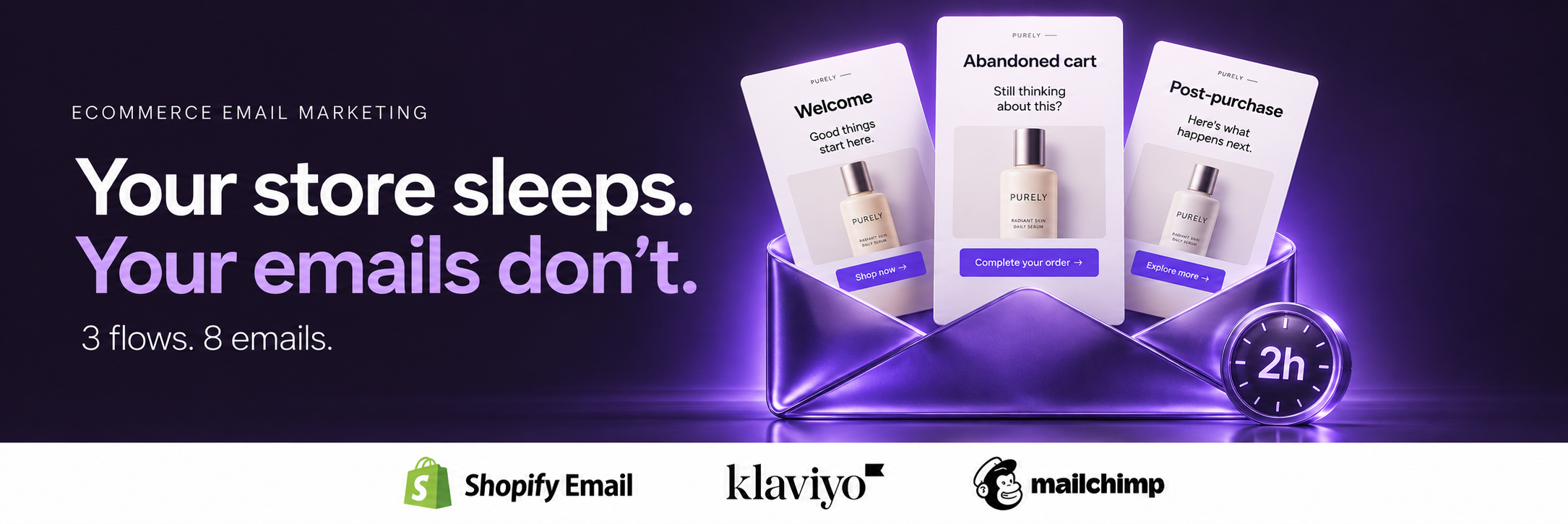
Let’s count. Three automated flows: a Welcome series of three emails that converts subscribers into buyers. An Abandoned Cart series of three emails that recovers lost sales. A Post-Purchase series of two emails that collects reviews and drives repeat purchases.
One popup collecting emails at a 3-5% conversion rate.
Eight emails total that run on their own. Without you. Every day. Every night. You set them up once and forget about them. And they keep making money.
What Kind Of Results To Expect
I’m not going to promise millions in month one. But here’s a realistic picture.
First month:
somewhere around 50-200 new email subscribers depending on your traffic, 5-15 extra sales just from abandoned carts, and 10-20% of new subscribers converting through the welcome series. These are sales you wouldn’t have had without email. Period.
After three months:
a list of 500-1,000 subscribers, email becomes a steady channel bringing in 15-30% of your total revenue. You start worrying a lot less when Facebook Ads has a bad day.
After six months:
list of 1,000-3,000, you’re sending regular campaigns now, new products, promotions, useful content. Email is driving 25-40% of all your revenue. This is your channel. Not Facebook’s. Not Google’s. Not someone else’s algorithm. Yours.
What You Definitely Don’t Need At the Start
Weekly newsletters.
Until you have 1,000+ subscribers, regular campaigns just don’t make sense. Open rates will be low, data won’t be meaningful. Focus on the automated flows. They run themselves.
Beautiful designer templates.
I know, you want it to look “nice.” But the truth is, simple text-based emails with one photo and one button convert just as well. Often better. Because they look like a message from a person, not a glossy brochure headed straight for the trash.
A/B testing everything.
With a list under 500, your tests have zero statistical significance. You’ll be making decisions based on noise, not signal. Just do what makes sense and start testing when the list grows.
Twenty flows at once.
Three flows. Eight emails. Full stop. Add more when you see what’s working and what needs to improve.
Mistakes I See All the Time
Not collecting emails from day one.
This one hurts the most. Every day without a popup is dozens (and with decent traffic, hundreds) of people you’ll never see again. They came, they looked, they left. Gone forever.
Offering a discount right away in the first abandoned cart email.
Bad move. You’re training shoppers to dump their cart and wait for the deal. They figure it out fast. Discount only in the third email. Only for the people who won’t come back without it.
Not thinking about mobile.
60-70% of people open email on their phone. If your email falls apart on a small screen, the button is microscopic, and the image takes a minute to load, they’ll just close it. Check every email on your phone before you launch it.
Not segmenting at all.
Even the most basic segmentation, bought vs. didn’t buy, lets you send different messages to different people. And that makes a real difference in conversion.
SMS: For Those Who Want To Go Further
Once email is running smoothly, you can plug in SMS. Open rates in eCommerce are over 90%. Ninety. Compare that to 20-25% for email.
But there’s a catch. SMS is a very personal channel. People don’t like unsolicited texts on their phone. Maximum 2-4 messages a month. Only the important stuff: a real discount, a new collection, order status updates. Nothing more.
Platforms for SMS: Klaviyo (built in, if you’re already on it), Postscript, or Attentive. But start with SMS only after your email flows are working and you’re seeing results.
What To Do Right Now
Hour one:
pick your platform, set up the popup, build your welcome series of three emails.
Hour two:
set up the abandoned cart series of three emails and the post-purchase series of two emails.
That’s it. Eight automated emails that from this moment forward work without you. And start bringing in extra revenue from week one.
Need help getting it set up? We build email marketing for clients end to end: from the popup to fully configured flows.
→ DM on Instagram: @iadsy_com
→ Telegram: t.me/iadsy_ecom
→ Or via our website: iadsy.com
Or .
Vasyl Staroshchuk
Co-founder of iAdsy
I’m Vasyl, co-founder of iAdsy. We build, fix, and scale eCommerce stores. 15+ years, 120+ projects, US and EU markets.
Build it. Launch it.
Keep getting better.
eCommerce Next Level · An 8-week live course